Andrew Bourdain wanted to travel, to eat and to womanize. Neocon CNN bosses wanted him to deliver a moral message. People under oppressive regimes -- not supporting US foreign policy that is -- eat poorly and look grim. People under progressive governments -- the US puppets -- eat well and are generally happy. He finally was done when under the influence of his overbearing new girlfriend, he started to be a spokesman against sexual harassment in high places. But for the CNN bosses, Dershowitz was too close to home. Bourdain, a vulnerable romantic, could not bear the brunt.
My blog reviews movies as political, historical or social commentary with intentional disregard for their artistic or cinematic value. One foe of American political scientists and economists is that they ignore movies as sources to inform them on changes in American culture, view exoticism as a hallmark of "foreigness" and, at the same time, impart American values and judgment to foreign movies.
Saturday, January 29, 2022
Saturday, December 25, 2021
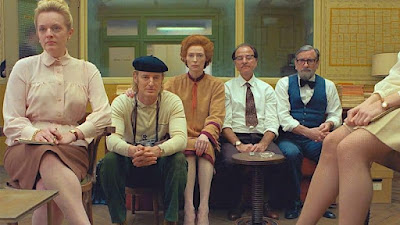
Wes Anderson. French dispatch.
After a relatively flabby -- for him-- but grandly rewarded by the Hollywood, "Grand Budapest Hotel", Wes Anderson rehabilitated himself by his latest "French dispatch". His stellar status has grown so much that major stars such as Adrien Brody, Elizabeth Moss, Saorise Ronan, Willem Dafoe and Leah Seydoux agree to play cameos in his movies, some being dressed in totally unrecognizable attire, without one thereof or in quite subdued roles.
The critics who consider this movie disorganized simply cannot handle cinematic art divorced of a specific "moral" message, usually feminist, racial, anti-Russian or some other kind. It shares the same name-dropping routine as the "Mank". Namely, the person other than a graduate student in American journalism has to do a prominent search in Wikipedia -- inconvenient in a dark movie theater -- to get any idea of his allusions.
Why Brody's character, whose prototype was strangely identified with David Duveen by the cineasts -- despite his lack of promotion of the modernist art -- is being made up and dressed like Jean Cocteau, who indeed was a tireless promoter? Is "French dispatch" a code word for "New Yorker" -- again the majority of the cineasts' suggestion -- or "Paris Review", which is the minority opinion? Was this ambivalence random or contrived by Anderson? Why the 1968 revolutionary leader is called Zeffirelli and what connection that has with the opera? Because he could not be called Feltrinelli or Cohn-Bendit? His is a very American movie despite being set up and filmed in France -- and obviously the member of New York cultural elite can explain all the minute details by Anderson -- but it is good all the same.
Saturday, December 11, 2021
Encanto.
Formulaic plot; but an inventive combination of realistic and psychedelic uses of color and light. Also a very creative implementation of movements and sequencing of plans from far-offs to close-ups. Altogether wonderful.
The House of Gucci
Unlike "The Last Duel" where the same director could have added a depth of character at the expense of historic accuracy, the House of Gucci shows the family struggles of the rich and famous with a hefty dose of psychological realism. And Lady Gaga can act. The only unworked line was Adam Driver's character turning from a "boy next door" into a sybarite capitalist shark under the influence of his overbearing wife only to reveal his lack of business acumen in ceding control of his company to the Bahrein investors.
Saturday, November 27, 2021
The Spine of the Night.
A rotoscope movie, extremely inventive in details and successfully merging Western comic and anime styles but totally senseless.
Dune.
Saturday, October 23, 2021
Ridley Scott. The Last Duel.
The action is good, period details are excellent but the movie characters are underdeveloped. There is no ambivalence in them. Ridley Scott freely borrowed cinematic stuff from Alaine Resnais--repeated shots of the same scene to enhance realism, and used the template of the "Return of Martin Guerre".
I am sure that his characters were such in real life: J. de Carrouge was a dependable but tempestuous and semi-literate boor, his wife--a wronged woman, LeGris--a social climber devoid of any scruples and Count d'Alencon--a scheming Renaissance prince straight from Machiavelli--enlightened but ruthless and immoral. But this does not make a movie interesting. I would wish a conscious retreat from the historical chronicles--that LeGris was really madly in love, that Marguerite was torn between her true feelings and conjugal duty, and that the Last Duel was essentially a glorified suicide of LeGris to save the honor of his beloved, even at the cost of his own soul--not a trivial consideration for the Middle Ages.